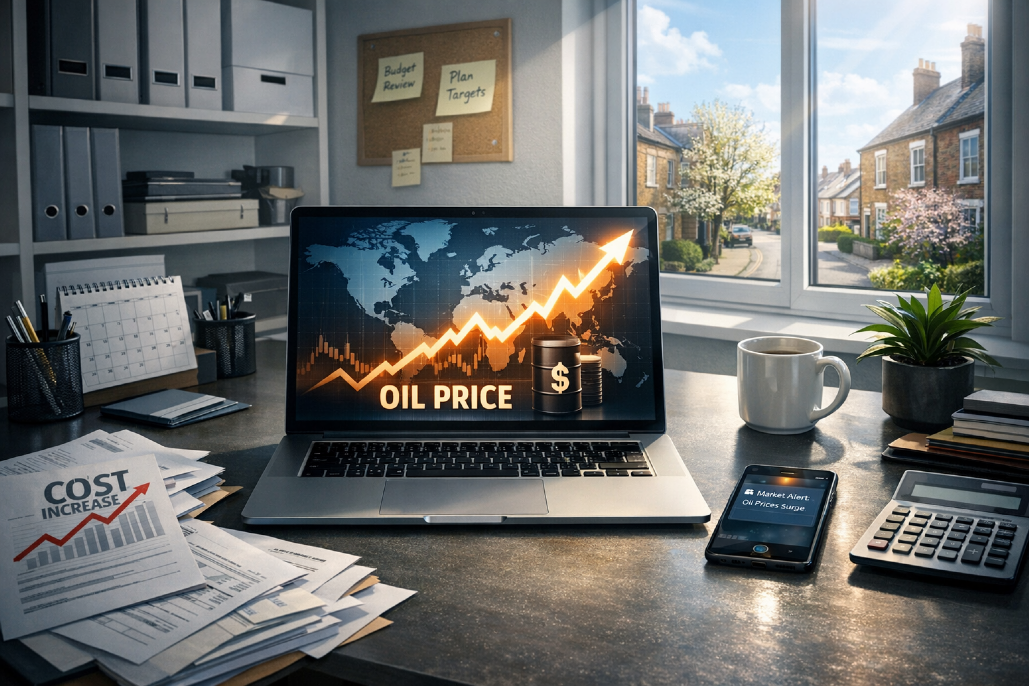
When most people hear about rising oil prices on the news, it's easy to switch off and go and do something more interesting instead. It can feel distant, global, and not particularly relevant to day-to-day business life. But in reality, the price of oil has a direct and often immediate impact on businesses of all sizes, whether you use fuel heavily or not ...
Why the price of oil matters: A closer look at how global oil prices can significantly impact your business
At its simplest, oil is still one of the foundations of the global economy. When its price rises, the effects ripple across the economy quickly. Fuel is the obvious starting point. Petrol and diesel costs increase, directly affecting any business that relies on transport: deliveries, travel, logistics, or even just commuting.
But that's only the beginning!
Transport costs don't stay contained. When it becomes more expensive to move goods around the country, suppliers pass those costs on. That means higher prices for raw materials, stock, and finished products. Over time, those increases filter through to customers, often leading to reduced demand or tighter margins.
We all rely on electricity and gas, both of which are closely tied to global energy markets. When oil prices surge, energy costs tend to follow. Recent reports suggest some businesses could see electricity bills rise by up to 30% and gas costs by as much as 80% in volatile periods.
For small businesses especially, that kind of increase can't just be absorbed; it has to be managed, passed on, or offset elsewhere. It hit harder and more quickly.
Then there's the wider economic impact. Higher oil prices often drive inflation, as the cost of producing and transporting goods increases across the board. In response, central banks may raise interest rates to keep inflation under control. That means borrowing becomes more expensive, affecting everything from business loans to mortgages and investment decisions.
This is where things start to tighten. Customers facing higher living costs tend to spend less, particularly on non-essential goods and services. Businesses can find themselves squeezed from both sides: rising costs on one hand and reduced demand on the other.
There's also the issue of supply chains. Global events that push oil prices up, such as geopolitical tensions or disruptions in key shipping routes, can slow down or interrupt the movement of goods. That can lead to delays, shortages, and further cost increases. Many businesses are already reporting concerns about supply chain disruption linked to rising energy costs.
So what does this mean in practical terms?
It means keeping a closer eye on costs than ever before. It means building flexibility into pricing and planning. And it means understanding that external factors, such as oil prices, are not just background noise, but real drivers of business performance.
You can't control global energy markets (if you can, we should probably be having a very different conversation), but you can control how you respond. If you stay aware, adapt quickly, and plan ahead, then you're far better positioned to ride out these shifts than business owners who ignore them.
In short, oil prices might seem like someone else's problem until they show up on your invoices, in your overheads, and start to affect your bottom line.
If anything I've written in my blog post resonates with you and you'd like to discover more of my thoughts about why the price of oil matters to business owners, then do call me on 01908 774320 and let's see how I can help you.
Don't forget to stay updated with our daily social media posts on Facebook.
Roger trained at Edward Thomas Peirson & Sons in Market Harborough before working at Hartwell & Co, followed by Chancery, as a partner. He started Essendon Accounts and Tax with Helen Beaumont in 2014 as a general practitioner with a hands-on approach.
Roger loves getting his hands dirty, working with emerging, small-to-medium and family businesses to ensure they receive the best possible accountancy advice. Roger utilises an extensive network of business contacts to leverage the best guidance and practical solutions.
The start of the new tax year in April 2026 has brought a wave of changes, but for business owners and the self-employed, this isn't just background noise; it directly affects how you operate, report and plan ......
The risks of war to the UK economy are very real; they can quickly impact energy bills, inflation, and business confidence. My blog post today explains why both businesses and households should care, and why a fragile economy...
Statutory Sick Pay is changing this month to make SSP easier to access and faster to receive. More low-paid employees will qualify, and payment will start from the first full day off sick. Employers will need to update payrol...
Companies House accounts filing changes are on hold for now, so there is no need to rush into new software for the paused April 2027 plans. However, identity checks, fees and the CATO closure are still moving ahead, so keep a...
From what I've read, penalties for MTD for Income Tax are starting to look much less mysterious. The main message is simple: you get a penalty if you miss a filing deadline, collect points, and pay late if the tax is overdue....
The Companies House data glitch has left many wondering whether their records have been changed. The safest move is to review filings, confirm details, and report anything unusual quickly. A calm check now can prevent bigger ...
This week's blog post is a guide on how to identify fake invoices. They always show the small clues that catch big scams. I'll cover verification habits, process controls, and what to do if money has already moved. Think prac...
I find it really interesting that many businesses are avoiding VAT registration by keeping their turnover just below the VAT threshold. So why is it happening, and what does it do to growth? I also want to touch on smarter sm...
If you're a web designer, you've probably noticed the same pattern over the years. You build a website, deliver it, get paid once, and then ... nothin ...
Starting a property business is less about flashy successes and more about solid organisation, clear decision-making, and continuous learning. In this ...
Millions of pensioners will face tax on winter fuel payments if their income surpasses the new threshold. Some will have taxes deducted through PAYE, ...
Use AI as a research tool to spark ideas and speed up reading. Then verify, compare sources, and keep judgment yours. It's guidance, not gospel ... ...
All content on this blog, including but not limited to text, images, videos and audio, is protected by copyright. No part of this blog may be reproduced, copied, distributed, or otherwise used without the prior written consent of the author. Unauthorised use constitutes a breach of intellectual property rights.
Please note that many elements of this blog have been created using Artificial Intelligence (AI). As such, content may not always reflect verified facts or professional advice. The information provided is for general interest only and should not be relied upon as a sole source for making decisions, financial or otherwise. Readers are strongly advised to seek independent advice from qualified professionals appropriate to their country and situation.
The author of this blog, YourPCM Limited, and its directors, employees, and authorised agents accept no liability for any loss, harm, or consequence arising from the use or interpretation of content found on this site.
The sblogit.com platform is provided on an “as is” basis. By continuing to view or interact with this blog, you acknowledge and accept these terms. If you do not agree with any part of this notice, please cease using this site immediately.
YourPCM Limited is a company registered in the UK and operates exclusively under the jurisdiction of the laws of England and Wales.