








+44 (0) 1908 774320
   
Roger Eddowes

Essendon Accounts & Tax

Home of the Business Godparent ...

What does the duty on electric cars in 2028 mean for drivers?

Roger Eddowes

CREATED BY ROGER EDDOWES

Published: 23/02/2026 @ 09:00AM

#dutyonElectricCars #ElectricVehicles #EVRoadTax #VehicleExciseDuty #DVLA #UKTax

Wondering how the duty on electric cars will actually be charged from 2028? It's a mileage-based levy tied into the existing DVLA system, with estimates up front and a true-up later. Here's the practical shape of it, without the jargon ...

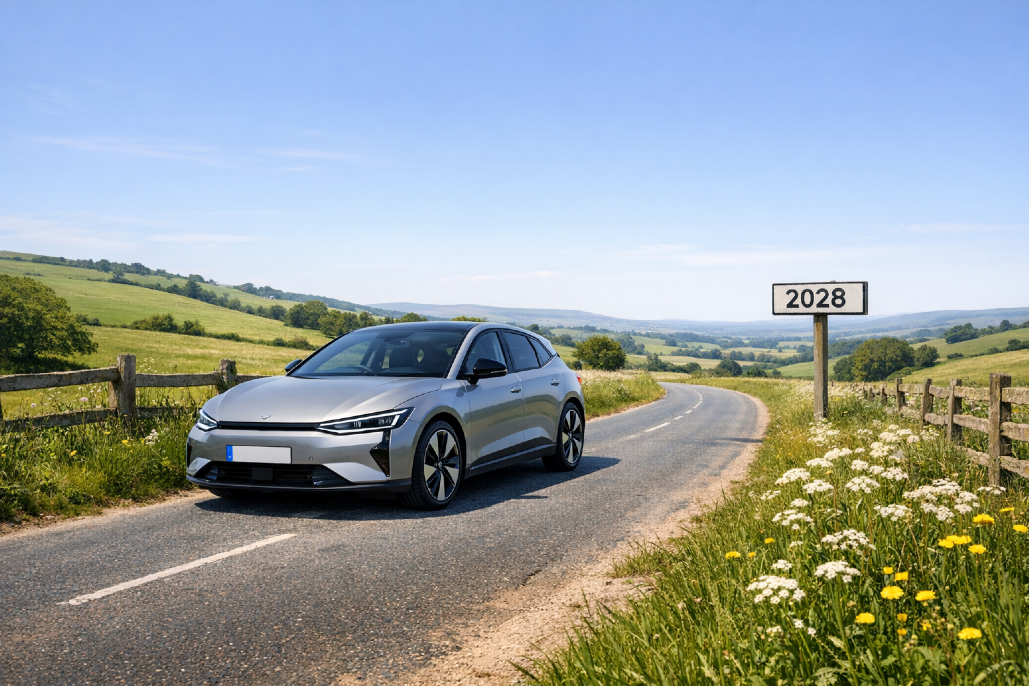
Duty on electric cars, Eco-friendly drive, Future in motion

Duty on electric cars, Eco-friendly drive, Future in motion

The duty on electric cars is designed to replace some of the revenue the Treasury currently gets from fuel duty, as more and more drivers move away from petrol and diesel. The logic is simple enough: if motorists aren't buying taxed fuel, the system looks for another way to reflect road use.

The policy aims to do this without putting people
off choosing zero-emission vehicles!

In practice, the levy sits alongside Vehicle Excise Duty, rather than replacing it, and it's expected to be administered through the same DVLA channels motorists already use for VED. That matters because it signals the government wants something familiar in form, even if the calculation is new. For drivers used to the usual EV road tax conversations and car tax bands, this is a shift from valuing ownership to measuring use.

The headline mechanic is mileage. A driver will be asked to predict how far the car will travel in the year ahead when the VED is due, then pay based on that estimate either in one go or spread across the year. At the end of the year, the driver submits the actual mileage, and the account is reconciled, so underpayments and overpayments can be corrected in a structured way.

That approach makes the duty on electric cars feel more like a pay-as-you-go system, even though the cashflow starts with an estimate.

Rates are expected to be set per mile and then uprated with inflation in later years. For 2028–29, the proposal is 3p per mile for battery electric cars and 1.5p per mile for plug-in hybrids, reflecting that plug-in models will still contribute through fuel duty. This is where the duty on electric cars tries to stay balanced: it charges for distance, but acknowledges that not all drivetrains are stepping away from taxed fuel at the same pace.

To keep the mileage figure credible, the plan
relies on annual checks!

Where a vehicle already needs an MOT each year, the mileage reading would be captured at the MOT and used as the anchor for reporting. For newer cars not yet in the MOT cycle, the expectation is that an accredited provider would check the mileage around the first and second anniversaries. It is deliberately administrative rather than high-tech, suggesting the government is aiming for compliance without turning the system into constant monitoring.

One detail that will matter to anyone who buys or sells used electric cars is how paid mileage is treated at the change of keeper.

The proposal is that mileage already paid for 'stays with the vehicle', meaning the financial history moves with the car rather than being wiped clean at sale. That makes the duty on electric cars partly a characteristic of the car's position in the year, not just the person behind the wheel, and it will likely influence how dealers and private sellers explain a vehicle's status.

Another point some drivers will clock quickly is that overseas miles are expected to count too, as long as the car is UK-registered. That means a holiday road trip on the continent isn't outside the scope just because it happened off British roads. From a policy perspective, it keeps the system consistent: mileage is mileage, and the duty on electric cars is based on distance rather than geography.

Responsibility is expected to sit with the registered keeper!

This is straightforward for most private owners, but more complex for fleets, company cars, and leasing arrangements. The government has signalled that these cases may need tailored processes, because the person driving, the person paying, and the person registered are not always the same. If this is implemented cleanly, it could prevent the duty on electric cars from becoming an administrative headache for businesses that are otherwise ready to electrify.

For motorists trying to place this change in the wider tax picture, it helps to think of it as a new layer rather than a replacement.

EV road tax has already moved away from the early era where electric meant broadly exempt, and the direction of travel is towards normalising electric motoring within the wider framework of vehicle excise duty and the existing car tax bands. The difference now is that distance becomes explicitly monetised, even for zero-emission vehicles.

By April 2028, the key practical question won't be whether a driver supports the principle, but how accurately they can estimate miles and how painless the reconciliation feels. If the reporting and checking steps are smooth, the duty on electric cars will feel like a predictable running cost; if they are clunky, it will feel like a yearly audit.

Either way, the duty on electric cars is set to become a routine part of budgeting for electric motoring here in the United Kingdom from 2028.

Until next time ...


ROGER EDDOWES
Join our mailing list! Click here and be one of the first to know when we publish a new blog post!


Would you like to know more?

If anything I've written in my blog post resonates with you and you'd like to discover more of my thoughts about the new duty on electric cars starting in 2028, then do call me on 01908 774320 and let's see how I can help you.

Don't forget to stay updated with our daily social media posts on Facebook.

Share the blog love ...

Share this to FacebookBuffer
Share this to FacebookFacebook
Share this to TwitterTwitter
Share this to Linkedin (popup window)Linkedin
Share this to Pinterest (popup window)Pinterest
Share this to WhatsApp (popup window)WhatsApp

#dutyonElectricCars #ElectricVehicles #EVRoadTax #VehicleExciseDuty #DVLA #UKTax

About Roger Eddowes ...

Roger Eddowes 

Roger trained at Edward Thomas Peirson & Sons in Market Harborough before working at Hartwell & Co, followed by Chancery, as a partner. He started Essendon Accounts and Tax with Helen Beaumont in 2014 as a general practitioner with a hands-on approach.

Roger loves getting his hands dirty, working with emerging, small-to-medium and family businesses to ensure they receive the best possible accountancy advice. Roger utilises an extensive network of business contacts to leverage the best guidance and practical solutions.

More blog posts for you to enjoy ...

Click here to view this blog post


HMRC's final MTD nudge letters: what self-assessment taxpayers should do now

HMRC is issuing MTD nudge letters based on 2024/25 returns, and some may arrive in late March. If your income tops £50,000, action may be needed even without a letter. If you receive one, read it, confirm your status, then si...

Click here to view this blog post


Planning ahead for the 2026 tax year-end: Practical moves for tax payers

Here's a useful run-through of what to review before the tax year-end on the 5th of April 2026. It covers business allowances, dividend changes, ISA tweaks and upcoming property surcharges. Think of it as a quick nudge to pla...

Click here to view this blog post


Why the HMRC self-assessment tax return deadline keeps catching people out

About a million people missed the HMRC self-assessment tax return deadline, and the knock-on costs can really add up. My blog post this week walks through why it happens, what HMRC fines can follow, and the smartest next step...

Click here to view this blog post


Are we heading towards a Digital Pound? The BoE is certainly thinking about it

Here's what a digital pound could look like and why it's being explored by the Bank of England. It wouldn't replace cash, and it certainly wouldn't be classed as crypto. The next couple of years are about design, testing and ...

Click here to view this blog post


HMRC's Time to Pay agreements: a simple way to help pay your tax bill

Need time to help pay your tax bill? HMRC's Time to Pay arrangements can spread a Self-Assessment balance into manageable monthly payments. File early, set up a plan if eligible, and keep an eye out for scams ......

Click here to view this blog post


Cybersecurity tips for protecting your business, family and personal data

Here are some cybersecurity tips you can actually use day to day, without getting overwhelmed. Learn how to spot common scams, verify requests safely, and lock down accounts with better habits. Think of it as a calm, practica...

Click here to view this blog post


Why small businesses are dropping the green agenda as survival pressures rise

Cashflow is getting tight for many small businesses, so dropping the green agenda is now a logical survival step. That's quite understandable. This blog post looks at why priorities are shifting and how firms can still move t...

Click here to view this blog post


Can HMRC take money from your business bank account for unpaid tax?

Wondering if HMRC can take money from your business bank account? They can, but only in limited cases, using the Direct Recovery of Debts process after repeated non-engagement, as long as key safeguards are in place. The opti...

Other bloggers you may like ...

Click here to view this blog post


Welcome to YourBOT: The AI chatbot built for UK small businesses

Posted by Steffi Lewis on https://www.yourbot.uk

Running a small business in the UK isn't easy. Between customers, paperwork, marketing, late-night admin, and the never-ending ''I'll just sort this q ...

Click here to view this blog post


Coming Soon: smart document capture in Xero for faster bookkeeping

Posted by Alison Mead on https://blog.siliconbullet.com

Smart document capture is about to make getting documents into Xero much quicker. Upload, email, or snap a photo, and Xero will read it, prefill the r ...

Click here to view this blog post


How to be happy retiring from your consultancy, without losing yourself

Posted by Jacky Sherman on https://www.jackysherman.com

What makes a happy retirement when you've been in consultancy for years? It's less about stopping work and more about designing your identity, boundar ...

Click here to view this blog post


Why serviced accommodation in Milton Keynes outperforms hotels for modern work trips

Posted by Emily Freeman on https://blog.shortstay-mk.co.uk

If a hotel room feels like living out of a suitcase, there's a far better option. Our serviced accommodation in Milton Keynes offers space, privacy an ...

© 2026 by Roger Eddowes

All rights reserved


All content on this blog, including but not limited to text, images, videos and audio, is protected by copyright. No part of this blog may be reproduced, copied, distributed, or otherwise used without the prior written consent of the author. Unauthorised use constitutes a breach of intellectual property rights.

Please note that many elements of this blog have been created using Artificial Intelligence (AI). As such, content may not always reflect verified facts or professional advice. The information provided is for general interest only and should not be relied upon as a sole source for making decisions, financial or otherwise. Readers are strongly advised to seek independent advice from qualified professionals appropriate to their country and situation.

The author of this blog, YourPCM Limited, and its directors, employees, and authorised agents accept no liability for any loss, harm, or consequence arising from the use or interpretation of content found on this site.

The sblogit.com platform is provided on an “as is” basis. By continuing to view or interact with this blog, you acknowledge and accept these terms. If you do not agree with any part of this notice, please cease using this site immediately.

YourPCM Limited is a company registered in the UK and operates exclusively under the jurisdiction of the laws of England and Wales.